Data Center Campus
QTS is exploring the opportunity to establish a new data center campus in the Village of DeForest. We are committed to being a responsible and engaged neighbor, bringing economic growth, environmental stewardship and a focus on community prosperity to the region.
Resources
Join QTS on Wednesday, November 12 for an opportunity to hear about the proposed project and share your questions. Members from QTS will share project details and be able to answer questions from the community.
On Thursday, November 6, QTS hosted a virtual community session about the proposed project and provided an opportunity for attendees to share their questions.
Hunter shares details on the company’s planned $12 billion data center project in Dane County, which is expected to create about 700 full-time permanent jobs in operations, maintenance, security and other areas. That’s in addition to the 5,000 expected construction jobs supported by the project.
Multibillion dollar investment positions Wisconsin to be a leader in sustainable AI digital infrastructure – built by the union workforce.
Proposed agreement supports sustainable energy generation and lowers costs for customers.
For more than two decades, we’ve built lasting partnerships with the communities where we live and work. We’re proud of these relationships and guided by our social values commitments. Together, we’ll continue to listen, support and grow with the people of Wisconsin as trusted neighbors in a shared future.
We are proud to partner with schools and tech programs to build the next generation of talent.
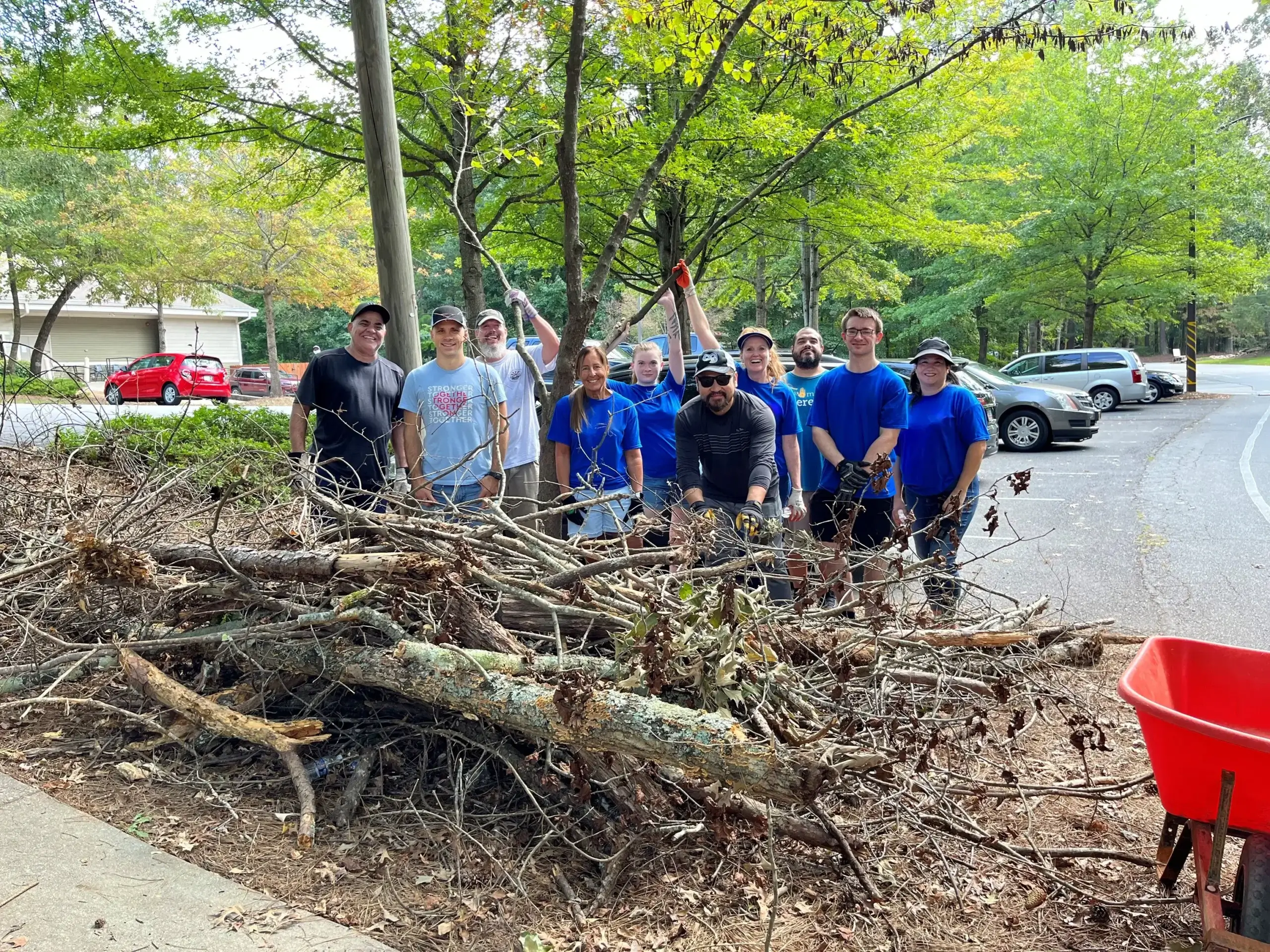
We build stronger communities by showing up. QTS associates receive nearly a week of paid volunteer time each year.
We invest in local organizations through grants focused on driving meaningful, lasting impact.
We proudly sponsor community initiatives that foster engagement and strengthen the neighborhoods we serve.
We’re committed to keeping Dane County informed and engaged at every stage.
A data center is a purpose-built building that stores a large amount of digital data. This data – and the applications used to create, process and share it – is housed in servers that reside within the data center. Data centers are vital hubs for businesses, governments and organizations that rely on technology.
There are many factors that QTS considers when looking at locations for data center development. Data centers require access to power, connectivity and a skilled workforce that not everywhere can provide. Another important factor is existing infrastructure that can support data center development, which this area already has established. Having infrastructure already in place significantly minimizes environmental and community disruption which is why we considered this site.
In addition to critical infrastructure already being in place, we believe construction jobs are important to be considered when assessing the total benefit of the project. Madison, Wisconsin is home to an incredibly strong construction force that is excited for the opportunity to work in their communities.
After months of community dialogue, planning discussions and careful evaluation, QTS determined that the Village of DeForest provides the most feasible path to responsibly advance this project.
This site was ultimately chosen because it already has the infrastructure in place to responsibly support a project of this scale. That means fewer impacts on surrounding areas and a faster path to delivering local benefits – including tax revenue, jobs and investments that support schools, services and community programs throughout Dane County.
This site was chosen because it has the infrastructure in place to support this project. That means fewer impacts on surrounding areas and a faster path to delivering local benefits – including tax revenue, jobs and investments that support schools, services and community programs throughout Dane County.
We understand that farmland is central to Wisconsin’s identity and economy, and we deeply respect the generations of families who have cared for this land. As we move forward, QTS remains committed to supporting local agriculture and the next generation of farmers through our community investment.
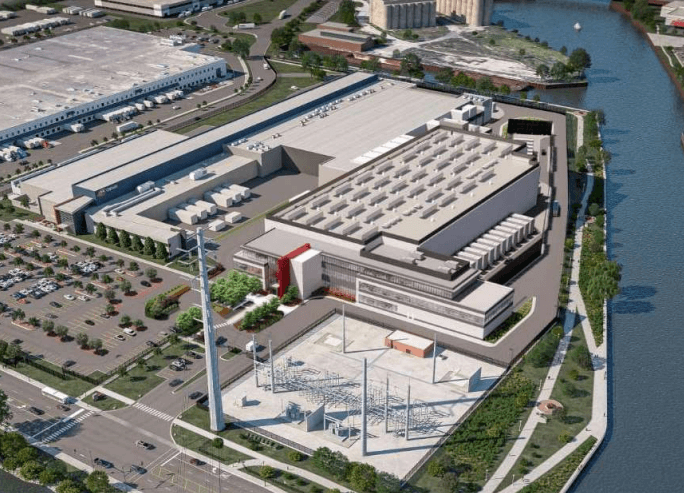
QTS Data Centers is investing in the future of Wisconsin with a proposed data center campus in the Village of DeForest. During the first phase, we expect to build 5 data center buildings across approximately 650 acres with plans for expansion over the next decade.
An initial site plan for the first phase (pictured) was included in our presentation to the Village of DeForest at the November 2025 board meeting. Please note, the rendering is for concept only. The designs are not final as we are still in early planning stages.
We have filed two annexation petitions to the Village of DeForest board for a total of approximately 1,600 acres. This acreage includes the entire campus which includes data center buildings, substations, wetland preservation and roadway and parking.
We have only secured power for Phase 1. Phase 2 remains conceptual and is not shown on the site plan for this reason.
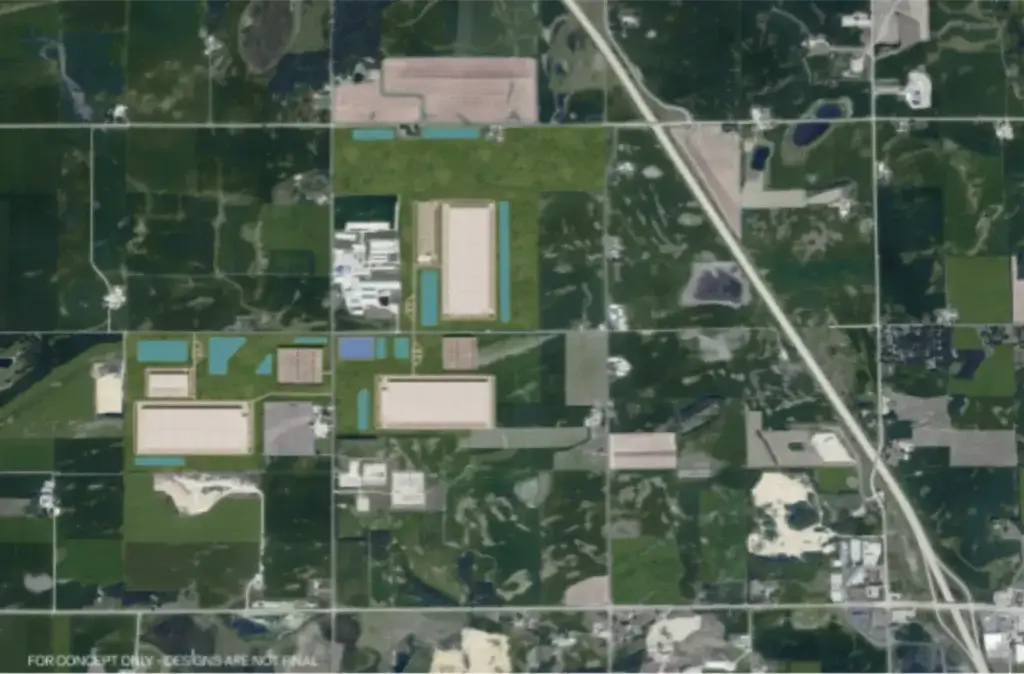
In the Phase 1 concept plan, the largest building is 1.9M square feet and the smallest building is 135K square feet. Please note these designs are still in the planning stage and may change.
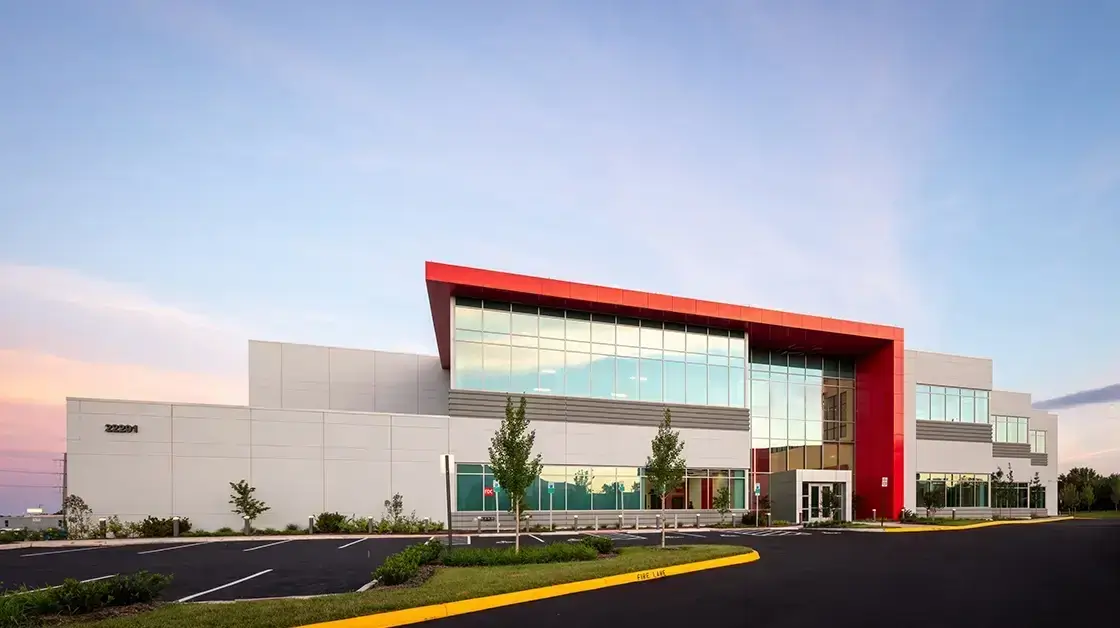
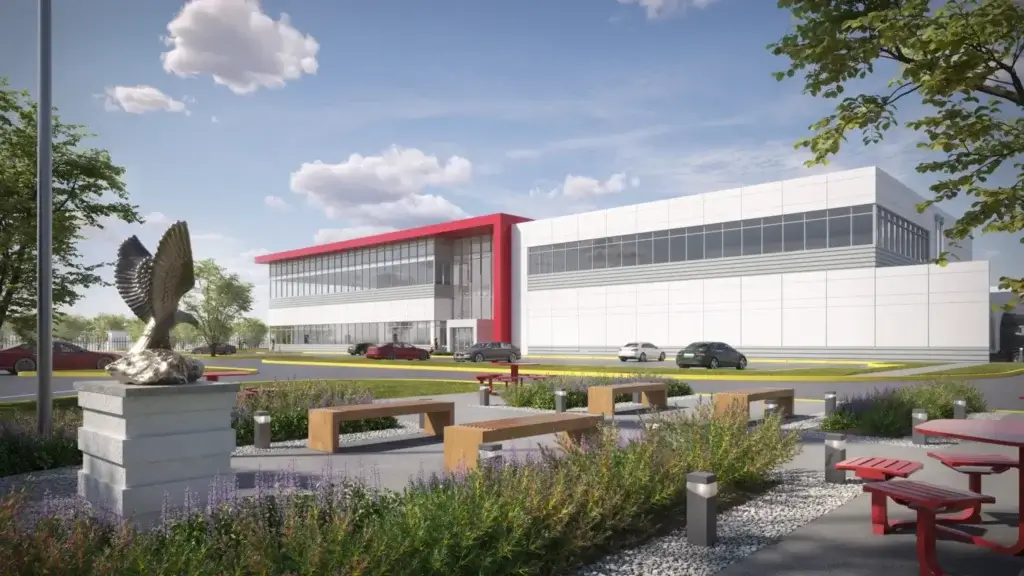
We take pride in constructing buildings with aesthetic appeal in the communities where we operate. We have a track record of working with local communities to ensure our buildings meet local design standards.
Although we are still in the early planning stages, we plan to minimize visual impacts on neighboring properties through substantial buffers and setbacks. We will incorporate buffer screens to conceal equipment from view and utilize landscaping techniques such as berms to enhance aesthetics.
The project represents a transformative investment in Wisconsin’s future, infusing billions of dollars into local growth and development.
It is expected to create thousands of construction jobs and hundreds of full-time positions, supporting local families and businesses and partnering with local building trades unions.
We estimate the project will generate $20 million in local tax revenue annually once phase 1 is fully built out and operational, creating an opportunity to reduce tax burden for residents and support services and community programs throughout Dane County.
This investment reflects our belief that responsible growth means shared prosperity for the communities where we live, operate and raise our families.
We estimate 5,000 construction jobs and 700 permanent jobs will be created during the development and operation of this data center campus.
The 700 permanent, onsite jobs reflect a combination of positions directly employed by QTS, jobs employed by our tenants, and jobs tied to campus operations such as maintenance. These numbers are projections based on similar projects. For example, in Cedar Rapids, we are currently hiring for 200 positions to support the operations of the first three buildings.
Beyond construction, data centers employ a wide range of jobs across operations, project management, procurement, logistics, security and maintenance/technology.
Skillsets range from technical (electrical, mechanical, IT certifications) to administrative and security. Importantly, our Data Center Academy program provides paid training for individuals with no prior experience, creating a pathway to become a Critical Operations Technician.
We typically pay an average $80,000 for an annual salary for a Data Center Technician.
We do not have a specific percentage goal, however we will prioritize local hiring wherever possible. Through partnerships with local schools, technical colleges, and workforce programs, we aim for a significant portion of roles to be filled by residents.
Our data center campus is designed with a potential gross capacity of 1,600 MW across the first phase. The second phase of development is conceptual at this time. Additional development beyond the first phase will depend on the utility’s ability to provide sustainable power.
It’s important to note that data centers rarely operate at 100% of gross capacity, and QTS does not control how much energy tenants consume within their leased space. Our responsibility is to deliver the infrastructure that enables tenants to monitor and manage their own energy usage effectively.
QTS will pay for all project energy infrastructure and there will be no cost impact to existing Alliant Energy customers as a result.
QTS aspires to source the maximum amount of carbon-free energy. In 2024, QTS achieved full utilization of carbon-free operational electricity across our facilities. We work closely with utility companies to identify innovative and sustainable ways to best serve the communities in which we operate in and the environment.
In October 2025, QTS and Alliant Energy announced an agreement in principle to enable renewable energy resources across Wisconsin, lowering the cost for Alliant Energy’s planned renewable facilities. This proposed agreement will be facilitated by the sale of Renewable Energy Credits (RECs) from approximately 750 megawatts of new renewable energy sources, which will help meet the growing energy needs of Wisconsin and support sustainable growth across the state, all while providing long-term benefits for Alliant Energy customers.
New data center developments are expected to boost energy sales. This increase in sales will help distribute fixed costs and transmission expenses across a larger customer base, contributing to more stable and manageable rates for the communities we have the privilege to serve.
As technology use grows, energy demand grows. Alliant Energy is ready. We are modernizing our energy infrastructure and advancing responsible solutions. Our “all of the above” energy mix balances new energy technology with traditional sources to deliver the reliable, responsible and affordable energy that matters most to the communities we serve. Our investments in new technology will further enhance efficiency and system operations as well.
As a utility, we continually take steps to ensure an adequate energy supply. While the energy growth we are seeing now is extensive, our systems and processes at Alliant Energy are centered on ensuring we have enough supply to meet demand. No customer, or group of customers, is “taking all the power” as we match supply with demand all day, every day. As a company, we are required to have enough power, plus a reserve margin, to serve customers no matter what and large energy users or data centers haven’t changed this for us.
New electrical infrastructure will be built on QTS or American Transmission (ATC) property. Any new transmission line infrastructure will be located on the project site, connecting the existing ATC substation to customer-owned substations.
QTS data centers are built with a closed-loop cooling system that does not consume water for cooling, once operational. Because our cooling technology uses a closed-loop, there will be no impact to water supply in Dane County or the Yahara watershed.
Once the cooling system is up and running, city water will only be used for everyday building needs – like bathrooms, kitchens, cleaning and landscaping – just like any other commercial building. An average facility uses less than 20,000 gallons/month.
The closed-loop system that cools the data hall uses only water. We will need to initially charge the system with a one-time fill. The total initial charging volume can vary widely based on a variety of factors including power capacity and facility design. Since we’re still early in the planning stage for this development, it’s hard to predict the exact amount of water needed. As an example, a data center building at our Cedar Rapids data center campus will use 2.5 million gallons of municipal water supply to initially charge the system.
We’re currently in discussions with the Village of Deforest to identify the best solutions to support the initial fill. This may be a mix of municipal supply, imported water or use of the rights in existing onsite wells.
The data center won’t affect the Village’s approved water withdrawal limits. Our engineers have confirmed that the existing system can handle the data center’s water needs. Any infrastructure costs associated with this project are paid for by QTS and therefore not passed on to residents.
The analysis completed by QTS and Village engineering indicates that there is adequate capacity in the existing system to support the proposed development.
Because our cooling technology uses a closed-loop, there will be no impact to water supply in Dane County or the Yahara watershed.
Today, stormwater management controls are not existent as the area is undeveloped. QTS’s design contemplates that stormwater runoff will be the same, in isolated areas, or better, in the macro condition, than it is today. All stormwater management efforts will meet local and state standards. The site plan we submitted includes basins that hold, filter and slowly release water to control flow, volume and quality.
Additionally, we studied how water moves across the land now and have proposed a site design to keep those patterns. The east and northeast areas naturally hold water, so we’ll restore those wetland-like areas to capture and absorb rain. The south and southwest areas drain toward a ditch that connects to the Yahara River. We’ll add stormwater systems there so runoff from new surfaces matches or improves on current flow. Some water in the south and southwest areas will still flow downstream, as it is important to still provide minimum drainage flows to the downstream drainage basins that depend on the upstream flow.
In our plans, we have set aside a number of acres to preserve and enhance wetland habitat. While plans are still being finalized, we are committed to maintaining and improving existing wetlands to support native plants and wildlife, working with local conservation and environmental organizations to ensure best practices, potentially creating educational or stewardship programs with local schools.
Additional efforts are being explored with the Village to create opportunities for recreation such as walking, biking and snowmobile trails in the area as part of the project. As plans progress, we will share more details and invite community input. Our commitment is to make this land a resource that benefits both the environment and the local community.
Diesel generators are used for emergency backup purposes only and are not the main source of power for our data centers. Generators are tested once a month for a short period of time for routine maintenance. Our diesel storage tanks are double-walled and equipped with interstitial leak monitoring and containment systems to minimize noise and ensure environmental protection. Additionally, our generators come equipped with high-efficiency filters to protect air quality and reduce emissions. These filters help minimize air pollutants and noise levels to keep the community safe in the limited cases that backup generators are needed.
QTS will apply for an air permit to the Department of Natural Resources (DNR). The DNR is the delegated permitting and enforcement arm, from the US EPA under the Clean Air Act, to ensure that air pollution is within acceptable levels.
Any equipment that QTS or our customers use, we recycle. In most cases, old electronics are typically used to build new component parts.
A common misconception is that living near a data center poses increased health risks due to radiation. All buildings regardless of usage and occupancy emit electromagnetic radiation. In fact, data centers emit levels of electromagnetic radiation comparable to those of standard commercial or residential buildings. Extensive research has been conducted, and no evidence has been found to conclude that exposure to low level electromagnetic fields is harmful to health.
QTS has committed to, and already began, an acoustic analysis to ensure we comply with the proposed decibel thresholds and all local, state and federal noise emission regulations.
Our data centers are designed not to exceed permissible noise levels, and we implement a variety of sound mitigation strategies, including equipment enclosures, sound barriers and strategic grading and site layouts fit for each development.
QTS data center buildings are constructed to meet or exceed green building standards, which includes responsible lighting design. The lighting strategy will mitigate impact to wildlife and natural areas by implementing special lighting techniques. These include using directional lighting pointed downward and covered to reduce light pollution, lower wattage and brightness levels, motion sensors and automatic systems to avoid unnecessary lighting and landscaping to minimize light impact. All lighting plans will meet local and state code requirements.
During the first phase (about 3 years), we expect to build 5 data center buildings across approximately 650 acres with plans for expansion over the next decade.
The exact start date of phase 2 will depend on permitting, approvals and market demand.
Noise is anticipated during construction. QTS will comply with all required noise and zoning ordinances. In Dane County, standard construction activity is allowed between 7:00 a.m. and 7:00 p.m. on weekdays and Saturdays, with restrictions on Sundays and holidays unless special permits are obtained. QTS will work closely with our partners to ensure we’re working during standard and approved work hours. Work outside these hours typically requires prior approval from the local municipality or county zoning authority. If work is required outside of these hours, we will coordinate with the county and ensure the community is notified in advance.
During construction, we will work with our partners to implement a variety of practices to minimize dust, including applying temporary paving to construction roads, logistic areas and workforce parking areas; routinely watering down active work areas and haul roads; covering or stabilizing soil and material piles when they are not in use; limiting vehicle speeds on unpaved surfaces and using designated haul routes to reduce dust generation. These steps help ensure compliance with local regulations and we will monitor the conditions daily based on weather conditions and activity levels.
Some areas in our preliminary borings indicate the presence of shallow bedrock or very dense material that may not be able to be excavated with standard equipment. In this case, controlled rock blasting may be required. If the soil is suitable for excavation, blasting will not be necessary.
If blasting is required, it will be done under strict safety and environmental guidelines, with advance notice to the community. Our goal is to minimize disruption and ensure the process is safe for residents and workers. QTS will work with our construction partners to monitor the size and scale of every blast and share notifications related to timing. In many cases, these notifications are shared to all residents that have subscribed to these notifications via text message and automated calls. The sign-ups for notifications will be added to our QTS Wisconsin site page, and we will provide contact information for our General Contractor for any questions or concerns as it relates to rock blasting.
QTS is committed to being a good neighbor. Should blasting be required for the project, we will work with residents to conduct third-party existing conditions surveys of wells to baseline ambient conditions. If residents experience any issues as a result of construction activities, QTS will work with residents to correct any deficiencies.
QTS is committed to minimizing impacts on local infrastructure and ensuring safe travel for residents throughout the development of the project. In an effort to minimize impact, we plan to do the following:
QTS will take responsibility for restoring roads impacted by our construction activities to meet or exceed pre-construction conditions.
While data centers are critical infrastructure, they are among the most secure and reliable facilities in technology.
QTS data centers are designed with multiple layers of physical, technical and environmental security controls including biometric access controls, 24/7 surveillance and advanced cybersecurity protocols.
QTS data centers use high-security fencing, often 8 to 12 feet tall. This fencing is made of steel and sometimes topped with barbed wire for added protection.
Yes. Entry points are limited and secured with gates controlled by badge access, biometric systems and security personnel.
The DeForest Area Fire & EMS will be the primary responder for emergencies at the proposed facility. If the project moves forward, we will partner with the department to ensure they have the training, equipment and resources needed to respond effectively to an emergency and protect the community.
Data centers are built for long-term use and are designed to evolve with technology. While the physical structure remains durable and well-maintained, the internal systems (servers, cooling, electrical) are upgraded to keep pace with innovation and efficiency standards.
The QTS approach is modular and scalable, meaning we can integrate new technologies without major reconstruction. This ensures the facility stays operational for decades.
The proposed campus reflects QTS’s dedication to the community, investing in both digital infrastructure and the people and programs that strengthen Wisconsin.
QTS is committed to collaborating with local stakeholders in being a valuable partner to the Village of DeForest and Dane County.
We are excited to partner with the UW-Madison on its Advancing Data Center Sustainability initiative to explore innovation in sustainable digital infrastructure.
We also recently announced a separate $50 million investment to support local initiatives that strengthen education, workforce development, housing and other critical needs.
Additionally, QTS is proud to:
At the request of the Village of DeForest Board, QTS plans to resubmit a consolidated annexation petition in December 2025.
We will continue to work closely with the Village of DeForest and state agencies as the project moves through the review and permitting process, including environmental, economic and infrastructure assessments.
We will share updates and maintain open communication with local leaders, residents and community partners as the project advances.
For additional updates, resources and information about the Village of DeForest’s review and consideration of the proposed QTS Data Centers project, please visit https://www.engagedeforest.com/QTS.
We understand that projects of this scale raise important questions and concerns, and we take them seriously. We’re committed to providing clear, timely updates through our FAQ page and ongoing communications.
Residents can reach us anytime via [email protected], our website comment form, or at upcoming community events.
We’re QTS, a global leader in digital infrastructure with over 20 years of experience designing, building, and operating data centers that keep our world running and connected.
QTS is planning a new data center near Madison, Wisconsin.
See how our commitment to community and innovation extends across the Midwest. Check out our work in neighboring Iowa and Illinois to learn more about our Cedar Rapids and Chicago projects.
QTS is Powered by People who are here for you.
Stay tuned for updates on development.
Becoming one of the fastest growing data center companies was no accident. Our innovative thinkers are the go-to sources for the latest information in data service space.